Before the First Take: 10 Production Tips That Can Make or Break an International Indie Shoot
The camera is generally the most obvious equipment on set, but it’s rarely the thing that determines if an international project stays on time.
They tend to break up considerably more quickly. Location images can look ideal while disguising a load-in route that just won’t work. The local rental house has the camera body but not the lens mount or wireless video technology in the package. Talent is locked down, but never matched to final areas in usage rights. Everyone shows up ready to work, only to find that the permission is for the street and not the building door where most of the scene takes place.
These failures are felt more acutely by indie filmmakers, since there is less financial flexibility to absorb a lost half day, relocate a location, extend a rental or keep a traveling team another nite.
If artistic decisions are converted to operational questions early on, international production is considerably easier to handle. Here are eleven things to lock in before the first call sheet goes out.
1. Define What a “Local Crew” Actually Is
It’s hard to compare crew quotes to unclear job scopes.
In some markets, the job is a gaffer turning up with a tiny lighting setup. Elsewhere lighting equipment, transport, power distribution and technicians are quoted separately. Media management is sometimes with camera assistants, sometimes with a specific data job. The production coordinator may be responsible for transportation and permits, or may assign these duties to distinct professionals.
Send more than just a list of job titles. Please advise shooting format, estimated number of setups, hours, camera package, lighting, sound, location, travel expectations and what positions are already traveling with production.
That level of information helps worldwide production support teams and local vendors to price the same scope, not many distinct interpretations of the same shoot.
When missing duties show up on set the cheaper quotation is not necessarily cheaper.
2. Make the Location a Workplace, Not a Frame
Scouting photos address a creative question: is the place right?
Technical scouting answers a different question: can a crew really work there?
Check distance from car access to set, width of staircases, access to goods lift, parking limits, holding area, bathrooms, hair-and-makeup space, power access, ambient sound, mobile reception, nearby construction, public traffic, direction of sunlight and weather exposure.
Imagine a fourth-floor flat with no elevators. The director wants a little nite scene, but the lighting team has to lug stands, fixtures, wire, grip and camera support up a narrow staircase. That access problem increases the prep time, the staff requirements and maybe the equipment package.
Beautiful places become expensive quickly when access info comes in after the schedule is created.
3. Distinguish Permission from Practical Control
Just because you can video doesn’t mean the team has control over what you can see or hear in the scene.
Different approvals or limits often apply to public highways, building exteriors, surrounding businesses, music playing in a venue, branded signage, artwork, private property, drone airspace and recognizable members of the public.
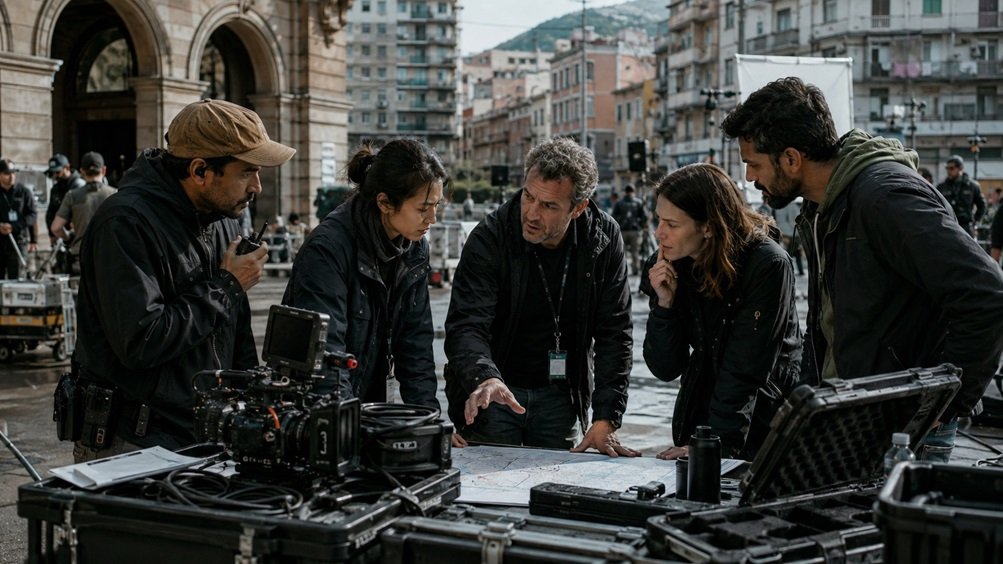
Map out the frame before shoot day. Decide what the camera will see, where the team will be, where equipment will go, what areas need control, what is outside the property line.
Documentation deserves some attention too. Location agreements, appearance releases, copies of permits, insurance certificates and special-access permissions need to be in the hands of the people who will require them. Having the only signed copy buried in an email thread doesn’t do much for a location manager dealing with security at 6:00 a.m.
4. Build the Equipment List Around Compatibility
“Available locally” is too wide to approve an equipment package.
Check real camera models, recording formats, lens mounts, lens coverage, filters, batteries, chargers, media, tripods, heads, wireless video, timecode, sound interfaces, monitors, power distribution, stands, rigging and expendables.
This same care is needed with substitutions. Changing lens sets alters things like minimum focus, flare behavior, weight, filtration and gimbal balancing. Another wireless system may have monitoring constraints. You can get the output you need using locally available lights, but at a cost of more electricity than the place can safely give.
Request a final itemized confirmation of equipment before to the shoot and clearly note any substitutions that are accepted. We don’t want to take away flexibility. It is to prevent flexibility from becoming a surprise in prep.
5. Build the Day Around Movement, Not Scenes
Script pages don’t tell you how long a corporate transfer takes.
A simple journey can be a huge schedule event with loading out, traffic, parking, unloading, access checks, reconstructing the video village, relighting, talent reset, catering and location handover.
International crews also encounter unfamiliar traffic patterns, security procedures, city restrictions, weather behavior and local working customs. Mapping app travel time seldom accounts for the full movement of several vehicles carrying people and equipment.
Plan company relocations as manufacturing activities. If the day has three locations, ask what has to happen physically between the last take at one location and the first take at the next.
That question often reveals an unrealistic day before people get to set.
6. Define Overtime and Turnaround Policies Their Business is Before the Schedule
Indie productions sometimes consider overtime an emergency budget issue. In practice, it’s also a scheduling and crew management issue.
How long in a day can be depends on local labor arrangements, deal terms, transportation, meal timing, overnight rest, equipment returns, venue access, etc.
Clarify the working day, overtime increments, meal expectations, turnaround, night-work implications, transport after late finishes and any hard location curfews.
Let us assume an outside sunset is ninety minutes behind. The creative team may want to move on to the interior work, but the crew has an early call the next morning and the location closes at midnight. If there are no agreed boundaries, the production begins to negotiate under pressure rather than making a prepared decision.
7. Incorporate Weather Cover in the Creative Plan
A weather contingency is more useful when it guards certain scenes as opposed to a nebulous “rain plan.”
Decide which setups can go inside, which exterior shots need matching conditions, what gear needs weather protection, where the cast and crew can take shelter, and if vehicles can still get to the location after a heavy rain.
Another problem is continuity. Shooting half a dialog scene in overcast conditions and the reverse coverage in hard sun creates work for camera, lighting and post production. Often it’s cleaner to reschedule the scene than to try and fix a visual mismatch later.
This is where local production teams are especially valuable because they can spot seasonal patterns, exposed locations, drainage problems, access issues or practical alternatives before the call sheet becomes reliant on one condition.
8. Provide Casting with the Knowledge to Solve the Real Brief
“Male, 30s, professional look” will get you submissions, but it doesn’t necessarily get you the role.
The more information you have about the performance level, dialog requirements, language, accent, wardrobe considerations, physical action, rehearsal needs, exclusivity, shoot dates, travel, fitting time, usage period, media, territories and whether stills or behind-the-scenes footage are included, the more accurately casting teams will quote and search.
Clear usage on the commercials, branded films, music videos and promotional material. Sometimes performers agree to a filming fee but not unlimited global use across all platforms.
Extras and real people are held to the same discipline. Release procedures need to be appropriate to the intended distribution and not simply to the needs of shoot day.
If the production is building a team internationally then sourcing local production crew and specialists is more effective when each role is described in operational terms rather than a generic title.
9. Plan Post-Production Before You Have The Footage
Editors take over decisions on set
The speed at which material can be used after wrap is dictated by frame rate, codec, proxy workflow, audio naming, method of sync, slate information, LUT handling, file structure, card reports, backup policy and handover notes.
Deliverables complicate the picture. A project may require a 16:9 master, 9:16 social cuts, square versions, clean textless masters, multiple subtitle languages, short teasers, broadcast-safe audio, still grabs, and behind-the-scenes edits.
If you simply frame for the widescreen master, you will have unusable compositions on the vertical variants. Problems with graphics can occur when you avoid placing subtitles in the space where interviews are recorded. If room tone is missing or there are wild lines, a simple dialog edit can turn into a repair job.
Send deliverable specs to camera, sound, DIT, production and post teams before filming. Post production is not the department for fixing every unmade decision.
10. Establish Whose Authority to Invoke When the Plan Fails
In the end, every production makes a decision that wasn’t in the timetable.
The site is no longer available. Talent is smothered. Drone shot canceled due to wind. Production transport can’t reach the set. Equipment shows up with a bad part. Another setup, the director asks. Warning of a hard exit, the location manager.
When no one knows who can approve the alternative, problems develop slower.
Decide ownership throughout prep. **Give the director and producer creative changes.** Route budget changes thru the producer or whoever has financial approval. Safety calls should go to the responsible department and production leadership. No artistic commitment without operational feedback before any location changes.
Predicting every failure is not useful contingency planning. You need to know who gets the information, who weighs up the consequence and who can sign off the next step.
Preparation Preserves the Creative Work
Uncertainty does not make international shoots efficient. They become tough by knowing where uncertainty will hit hardest.
Crew scope, access, permits, equipment compatibility, company moves, overtime, weather, casting rights, data handover and decision power – all sound less fascinating than lenses or performances. But these are the systems that safeguard the time filmmakers require for both.
Indie productions gain disproportionate benefit from this practice. Every hour you save from avoidable misunderstanding can be spent on blocking, performance, lighting, coverage or another take.”
Before you lock the call sheet, read the plan as if you were the one who had to execute it. Learn what does the camera department still need to know, what does the location team still need to confirm, what has talent truly agreed to, what post will receive and what happens if the first option falls away.
The best manufacturing plan is not the one with the most paperwork. It’s the one that leaves less expensive questions to be answered once the crew is already on the ground.