
The Essential Role of Cinematography in Counterpart
Short films are often bound by the need for efficiency with quick pacing, clear dialogue, and a flexible editing structure to get the most out of limited time and resources. Counterpart, however, takes a radically different approach. With no spoken language, a single performer, and an unyielding interior space, the film strips away nearly every conventional storytelling tool. It’s a high-risk move, one that challenges traditional narrative structures. Without dialogue to articulate inner conflict or an ensemble cast to externalize tension, Counterpart relies solely on its visuals to effectively convey its narrative.
The responsibility for both narrative progression and emotional depth falls entirely on the cinematography. Without dialogue to articulate internal conflict or an ensemble cast to externalize tension, the film relies on a precisely constructed visual framework to carry the story. This approach forces the film to succeed or fail based entirely on its ability to communicate through visual design. Without this framework, Counterpart would not merely become abstract; it would lose its ability to convey meaning altogether.
Cinematographer James Nield takes an innovative and unconventional approach, using cinematography as the sole method to convey both narrative and emotion. By working within the confines of a single performer and a static interior, Nield crafts a visual language that not only supports the story but drives it forward. Every decision whether in framing, camera movement, or lighting becomes integral to the unfolding narrative, establishing a structure where the visual system dictates the story’s emotional beats and progression.
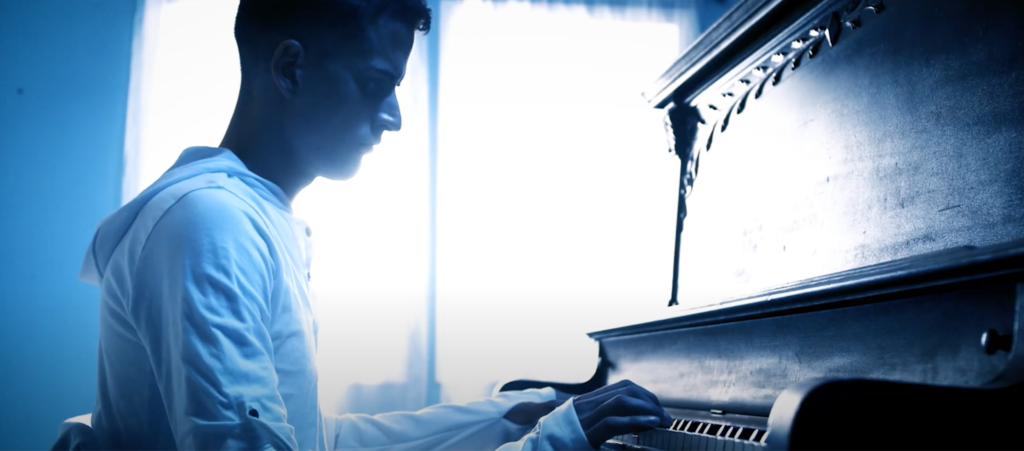
Rather than relying on isolated visual moments, the film’s cinematography follows a clear and consistent set of rules. Framing, camera distance, and lighting are kept intentionally stable for long stretches, so the audience becomes familiar with the film’s visual logic. When these elements shift, the change is immediately felt as narrative movement. Story progression is communicated through controlled visual changes, not through rising action or verbal explanation and depends entirely on the consistency of this visual structure.
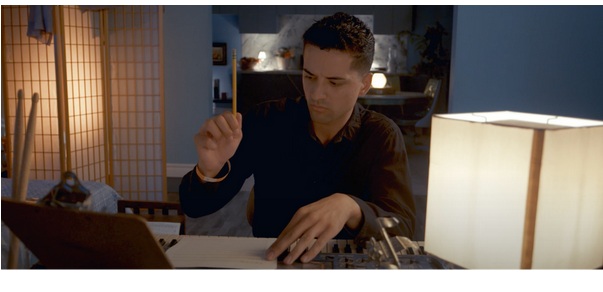
Nield uses color to differentiate and define the two worlds. Warm tones dominate the composer’s environment, grounding it in familiarity, while cooler, harsher hues establish the counterpart world, signaling unease and psychological dislocation. These shifts are gradual and carefully controlled, allowing the audience to perceive emotional change without dialogue or exposition. By sustaining mood across the frame, color becomes a tool for guiding emotional response and marking subtle narrative shifts.
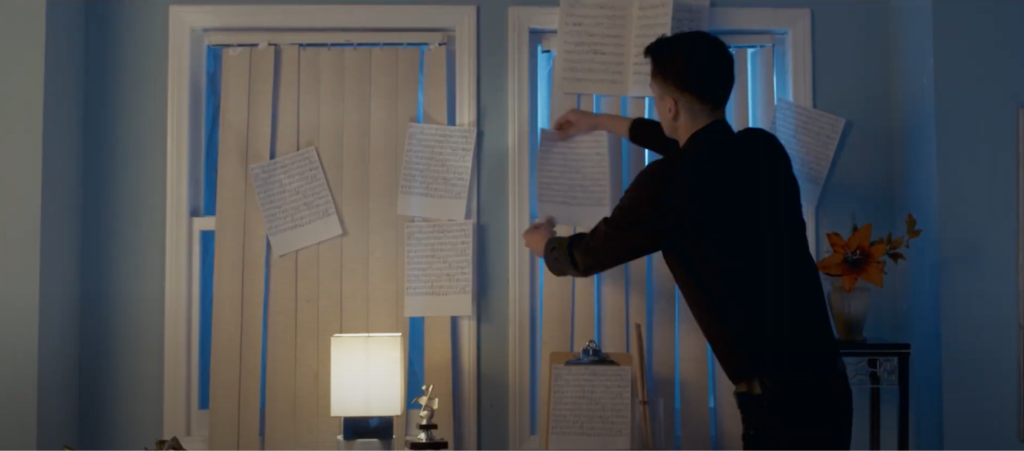
Composition and framing are applied with precision to create clarity and rhythm. Repeated camera distances and shot compositions establish a stable visual language, while tight framing conveys pressure, restriction, or internal conflict. Slight adjustments in angle or spacing are deliberately used to signal release, transformation, or psychological change. Every frame is structured to guide the viewer’s attention and communicate the character’s emotional state, ensuring that visual cues carry the narrative in the absence of dialogue or overt action.
Camera movement is minimal and deliberate. Extended still shots allow the audience to settle into the visual space, making each shift in distance or angle meaningful. When the camera moves, it punctuates emotional or narrative beats, emphasizing tension, release, or transformation. Gradual changes in proximity convey subtle shifts in internal state, while motion disrupts the stillness, drawing attention to significant psychological or narrative developments. By restraining movement, the film makes each adjustment purposeful, using it as a direct tool to communicate story and emotion.
Although Counterpart may not be a film for everyone, its success can be measured by the impact it achieves under extreme constraint. Dialogue-free short films often travel internationally as they remove language barriers. Telling a story with these extreme constraints presented a high-risk challenge, yet the film screened globally across 12 countries earning recognition at festivals and winning multiple awards for Best Concept and Experimental Film.
The film’s strong foundation has also sparked interest in expanding the project. Counterpart is potentially being adapted into a book, has attracted development interest from major studios for a potential series, and has led to a pilot titled Metronome, currently in development, extending the same conceptual framework into a longer format. Such a trajectory is rare for a short film of this minimal scale and unconventional structure, highlighting the durability and adaptability of its storytelling approach.
What sets Counterpart apart is not just strong cinematography, but the extraordinary narrative responsibility it carries. Unlike most short films, where visuals support dialogue or performance, here the cinematography drives the story, emotion, and structure, demanding precision, restraint, and systemic control. The film’s impact cannot exist independently of Nield’s visual system, altering it would dismantle the story rather than reinterpret it. Through disciplined and innovative visual design, Counterpart succeeds not in spite of its limitations, but because they are replaced with a coherent visual architecture capable of carrying the story’s entire weight.