Voice, Vision, and Venture: A CineTalk Q&A with Eric Kinkel on “In Search of His Lost Cords”
For a musician, the voice is more than just a tool; it is the core of their identity and the primary vehicle for their art. Imagine waking up to find that very gift; the ability to sing and even speak, has been abruptly silenced by a traumatic brain injury and subsequent medical complications. This is the harrowing reality faced by Illinois-based recording artist Eric Kinkel, who has spent the last several years navigating a medical labyrinth in search of answers that traditional treatments have failed to provide.
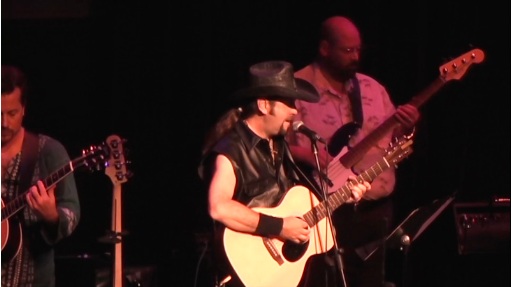
In this exclusive interview, we sit down with musician and Executive Producer Eric Kinkel, the subject of the new 90-minute documentary “In Search of His Lost Cords.” The film is not just a chronicle of his prolific career; from his early days in the Chicago music scene — including the moment he brought the Canadian Rock & Roll Hall of Fame trio Rush to his high school during his senior year for an intimate Q&A — to his extensive philanthropic work, but a raw, ongoing quest for recovery through cutting-edge science and AI. We discuss the intersection of filmmaking and resilience, and how this documentary serves as a digital beacon for the innovators who might hold the key to restoring his voice.
Q: What made you decide to tell your story through your documentary, “In Search of His Lost Cords,” while you’re still in the middle of this journey?
Eric Kinkel: After losing my vocal cord functions, my frustrations with conventional medicine motivated me to produce my documentary film. Desperation caused by major failures in the current healthcare system to find answers – and observing treatments that did more harm than help me. I want to share my story with the world: my talents, my accomplishments, as well as my heartbreak and despair at the lack of compassion and solutions. I want to stress that we are our own best advocates; we need to persevere despite others who don’t agree or support us.
Q: At its core, this film feels like more than storytelling, it feels like a search. Who are you hoping this documentary reaches that could help you in your journey to regain your speaking and singing voice?
Eric Kinkel: Beyond touching people emotionally with my life’s story, my mission is to reach those of notoriety in the greater science-based research and combined AI technology fields. Those who are on the cusp of realizing recoveries for anomalous conditions such as mine. I want to reach anyone who can act upon interventional basal ganglia and PONs recoveries – and who are not linked to big pharma or ineffective neurological care that has not succeeded in treating organic abnormalities such as mine.
Q: You’ve said that conventional treatments have not been successful and, at times, created additional challenges. How did that reality influence your decision to look beyond traditional pathways?
Eric Kinkel: After seeing one practitioner after another, and experiencing closed-minded and unsympathetic attitudes and ineffective medical treatments, desperation led me to strike out on my own quest for answers. I experienced numerous callous and dismissive reactions as a once-gifted vocalist and musician. On several occasions, I was bluntly told, ‘You will never sing again’ by specialists whom I trusted. I am now focusing on science-based solutions that were not considered by conventional medicine practitioners.
Q: The documentary shows you using AI to communicate today while still fighting to regain your natural voice. How do you view that balance between relying on technology now and continuing to pursue a full recovery?
Eric Kinkel: I used an AI voice generator in the documentary in order to telegraph my most sincere and unapologetic thoughts about how traditional medicine is out of touch with science. I can’t use AI every day. When I refer to AI combined with quantum computing models, I’m referring to the marriage of these emerging technologies to bring researchers faster results and not replacements for my very human and organic abnormalities.
I am determined to recover my real voice again and not rely on synthetic crutches because that can never relay the human voice I was gifted with at birth.
Q: Because of your limited ability to speak today, filmmaking itself becomes part of your voice. How did that shape the way this documentary was created?
Eric Kinkel: It was a new creative experience for me, encapsulating my life into a visual story combined with experiences I’ve been through on this long road to exacting upon rational and realistic science – based recoveries. Inviting friends and acquaintances who gladly offered their heartfelt testimonials helped my film speak to an audience about how my life touched them and their sincere desire to see me recover the original speaking and singing voices they remember me by. Altogether, it shaped the approach I took to telling my story more easily.
Q: In making this film, do you see it as raising awareness, attracting scientific interest, or both? What outcome would you consider a meaningful breakthrough as a result of people seeing your story?
Eric Kinkel: My quest is to usurp neurologists who are linear minded and seek out researchers who can bring cutting edge technologies to the medical community – either directly or through large universities or teaching hospitals. These institutions can implement such recoveries to singers like me, and other people who suffer from conditions with brain trauma induced movement disorders.
The conversation with Eric Kinkel reveals a profound intersection between human resilience and the frontier of medical technology. By documenting his struggle in real-time, Kinkel transforms his personal loss into a public mission, highlighting the limitations of current medical pathways while championing the potential of emerging interventional science and AI. His story is a reminder that the drive to reclaim one’s identity can spark innovation that benefits not just one individual, but an entire field of patients facing similar neurological challenges.
As “In Search of His Lost Cords gains traction,” it stands as a testament to the power of independent filmmaking to amplify voices that have been physically silenced. The journey is far from over, but the integration of archival history with a forward-looking search for a cure sets a new standard for medical advocacy in film. For Kinkel, the music remains within, waiting for the right breakthrough to allow the world to hear it once again.
To learn more visit https://insearchofhislostcords.com/
Watch the Film on Vimeo: https://vimeo.com/1148131948